EXPLAINING THE STRUGGLE FOR HUMAN RIGHTS IN RUSSIA |
|
|
Hello and welcome back to the Digest. |
Happy Thanksgiving to those celebrating! |
Today we will cover stories of digital and physical repression. Also — we are inviting you to an event, see more details at the end of the newsletter. But before we move on to the text I have to urgently ask for your support. Russian donation platforms have quit their collaboration with OVD-Info. This means that OVD-Info can no longer raise money in Russia, which was a major source of income for it. That is why your support is most necessary, especially today. OVD-Info uses the donations in order to deliver crucial aid all around Russia. Hundreds of people — lawyers, activists, prisoners — rely on them.
|
In solidarity, Dan Storyev, OVD-Info |
|
|
Donate to OVD-Info to keep us running |
|
|
Trigger warning:
This is a newsletter about Russian repressions. Sometimes it will be hard to read. |
|
|
Are there good Russians, really? |
|
|
If you follow the news and frequent social media, you might have been exposed to a slew of discourse online and in the halls of power— over the EU cancelling multiple entry visas for Russians. |
The decision was criticised from multiple angles. Some argue that it does little to stop potential Putin sabotage in Europe — after all, the men who recently blew up a rail track in Poland happened to be Ukrainian nationals, and there is no shortage of diplomatic passports or secret pathways across the border. Others, like renowned author Yelena Kostyuchenko, note that the decision throws a wrench into the functioning of independent newsrooms and activist collectives who still have people on the ground in Russia and need the flexibility to get them out at a moment’s notice.
|
In any case, I do not plan to debate the merits of the EU's decisions here. Instead, I want to paint you a picture of life in Russia today in two connected cases. This will hopefully shed some light on why people are seeking to flee to the relative safety of the EU. |
|
|
First, a little note on the Russian internet, also known as the Runet. The internet around the world is dying at an accelerated pace, primarily due to the overflow of AI content. In Russia this dying is exacerbated by repression. In wartime, where a poorly worded sentence might get its author jail time, online communities are closed, and web sites are taken offline. Calls in messengers are disabled in order to promote the thoroughly bugged, state-sponsored MAX messenger. VPNs are legal for now, and you have to use them daily if you would like to call your friends abroad. Some cities have frequent internet blackouts, especially the ones closest to the front, but also ones thousands of miles deep into Russia and Moscow itself.
|
|
|
And of course there are cases of persecution for simple shares on social media, and persecution for online posts. For instance, last year, 60-year-old Lyudmila Teteneva was sentenced to 8 years in jail for liking several videos on the Odnoklasniki social media platform, in which likes automatically share materials on one’s page. In court she said: |
| Lyudmila Teteneva / Photo: Social media |
|
|
|
I'm very ashamed, very disgraced, I admit my guilt. But please, if possible, reduce my sentence a little. I have grandchildren growing up, and I want to be with them. I deeply regret what I did! I think about it every day, I feel so bad! |
|
|
The court decided that 8 years was an appropriate sentence. |
Against this backdrop we now have the first ever example of persecution for browsing. A young man was recently accused of looking up “extremist materials” about the Ukrainian armed forces. The information was passed on to security services by the man’s mobile operators, his lawyer alleges. |
Valeria Vetoshkina, an OVD-Info lawyer, says she “doesn't recall any public discourse specifically banning the search for extremist materials, but it's clear that everything was moving in that direction—the state is trying to control information consumption.” |
|
|
But, this is the online space. What is happening in real space? If you briefly return online and Google something like “Moscow, daily life”, you will see something very similar to any European city. Bustling restaurants, bars and street musicians. But here is the catch: these street performers are not safe from repression either. |
The Stoptime case resonated domestically and globally. A trio of St Petersburg street musicians, headed by Diana Loginova aka Naoko, was performing songs by banned artists. All of them were jailed, and two are still in detention. Loginova has been repeatedly jailed for 2 week stints for administrative violations.
|
Yes, just singing a song might land one in jail in Russia. These banned artists’ lyrics are not calling for violence or extremism. Instead, the artists were punished — declared “foreign agents”, their songs taken off streaming — for their political stance. One such artist is Ivan Alekseev, aka Noize MC, whose song Light Streak, performed by Stoptime, went viral. |
|
|
|
But I believe there will be a bright streak
In this darkness, as impenetrable as snow at the poles
New stems will break through the ashes to the heavens
Dew will sparkle on the leaves in the rays of dawn |
|
|
Noize MC is considered a foreign agent by the Kremlin for his anti-war stance.
|
The band was performing this song and a few others near the aptly-named Uprising Square metro station. The people on the street treated Stoptime like a rally opportunity. Videos of a large crowd singing along to banned songs rapidly went viral, including amongst pro-Kremlin propagandists.
|
The propagandists bayed for blood. On 16 October the trio was arrested and sentenced to 12–13 days of administrative arrest for “disturbing public order”. At the end of the month they were all re-arrested. |
|
|
Diana Loginova and Aleksandr Orlov / Photo: SOTAvision |
|
|
While being transported in a police van, the group’s guitarist Aleksandr Orlov proposed to Diana. They want to get married. On November 9, the drummer Vladislav Leontyev was let go. Diana and Aleksandr remained in jail, rearrested. They were released in secret last Sunday and reportedly left the country.
|
This practice is called “carousel arrest”--when police use several consecutive administrative offense charges to justify keeping dissidents in short-term detention as long as possible (administrative charges that include this punishment usually allow up to 15 days per offense). Many times, the carousel arrest technique is used to keep a person in custody while the authorities are preparing a more serious criminal charge like treason. Valeria Vetoshkina says that while technically legal, “in reality, no criminal act has occurred (the person didn't swear in a public place, didn't resist a police officer, etc.), but rather, a far-fetched pretext exists to detain the person. During administrative arrest, a person is essentially left alone with law enforcement officers. It's during this period that critical errors most often occur, which subsequently allow law enforcement to easily initiate criminal proceedings.“
|
The authorities pounced on the opportunity to persecute the young musicians who became a small symbol of resistance. If you were wondering why people are trying to flee Russia, I hope this answers your questions. |
|
|
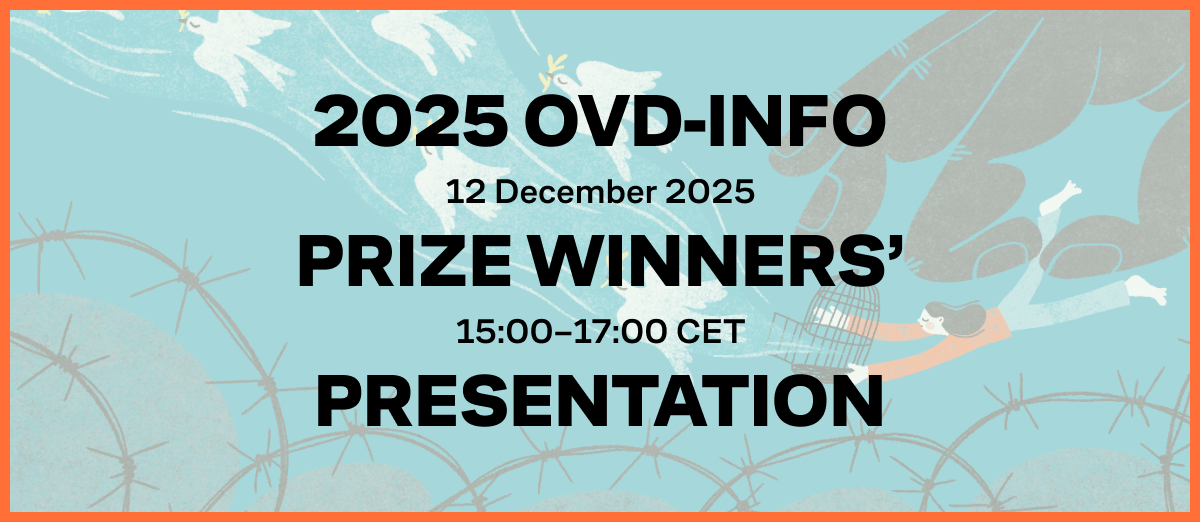
Join us to hear from award-winning researchers whose work offers deep insight into political repression, surveillance, and censorship in contemporary Russia — followed by an open discussion on the role of academic research in documenting and challenging state abuses. The event is open to researchers, journalists, human rights defenders, and anyone interested in these critical issues.
|
We look forward to your participation — please register via the form at the end of the announcement page. |
|
|
The OVD-Info Prize is an annual international award for the best Master’s and PhD research on political repression, surveillance and censorship in contemporary Russia. Launched in 2024 by the Russian human rights project OVD-Info together with EHESS-CNRS, Sciences Po-CERI and Paris Nanterre University, it supports young scholars in production of master theses and PhD dissertations on these subjects.
|
Eligible research may come from disciplines such as sociology, political science, law, anthropology, information and communication studies, geography, or any other closely related field, using qualitative and/or quantitative methods.
|
In 2025, we received 53 applications from students at 44 institutions across 18 countries, including the USA, Montenegro, France, Russia, Ukraine, the Netherlands, Norway, Spain, Germany, Czechia, Lithuania, South Korea, Ireland, Canada, Finland, Italy, and the UK. |
Of these, 26 works were shortlisted. In the final round, the jury selected 5 winners: 4 PhD projects and 1 master’s research project. |
At this public event, two of 2025 winners will present their research.
|
- Katyusha Behind Bars: A Dispositive Analysis of Commemoration in Russian Prisons
About the author: Ryan Reed is a doctoral researcher at the University of Helsinki in the Political, Societal, and Regional Changes programme. His doctoral thesis investigates how the contemporary Russian Prison Services (FSIN) contend with legacies of the past including the Stalinist and Post-Stalinist Gulag systems. - Homophobic Legislative Politics in Russia and Its Consequences: Systematic and Widespread Discrimination and Violence against LGBTQ People
About the author: Sergey Katsuba is a socio-legal scholar and PhD candidate at UCD Sutherland School of Law, studying LGBTQ rights and institutionalised discrimination in authoritarian regimes. His doctoral research investigates how political homophobia in Russia is embedded through legal, political, and societal mechanisms—examining how laws targeting LGBTQ communities reinforce authoritarian rule and enable violence
|
Join us on Zoom
Date: 12 December 2025, 15:00–17:00 CET
To register, please use this link. |
| |
Please answer our questionnaire so we can better understand our audience! |
|
|
The Digest is created by OVD-Info, written by Dan Storyev, edited by Dr Lauren McCarthy |
OVD-Info English newsletter privacy policy: how we work with your data |
|
|
|